
Corrections Don't Break Portfolios, Reactions Do
Uncategorized

Corrections Don’t Break Portfolios, Reactions Do

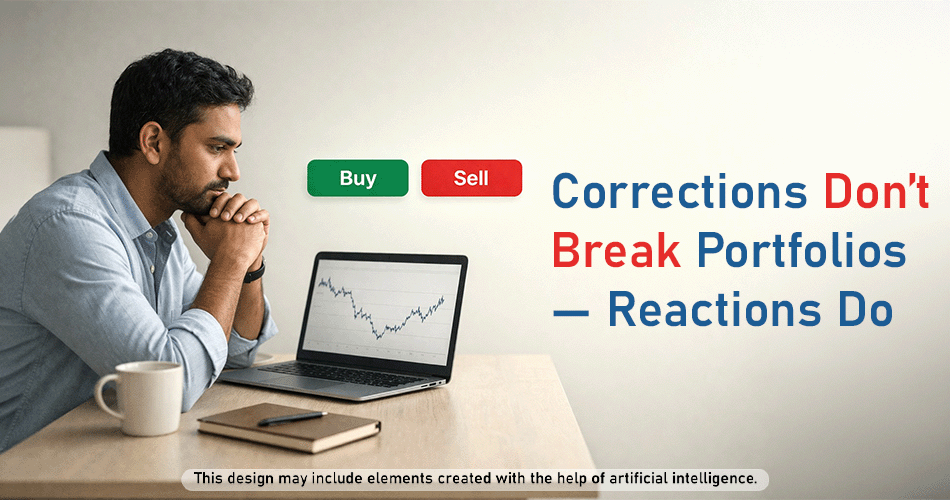
Corrections Don’t Break Portfolios — Reactions Do Every time markets fall, something familiar happens. Headlines get louder. Opinions multiply. Charts turn red. Conversations shift from optimism to concern almost overnight. Even investors who were calm just weeks ago begin to feel uneasy. Market corrections don’t just affect portfolios. They affect emotions. And that’s where the real damage often begins. A correction, by itself, is not unusual. Markets don’t move in straight lines. They expand, pause, adjust, and sometimes fall sharply before recovering. These movements are part of how markets function. They’re not interruptions to the system—they are the system. But while corrections are natural, reactions to them are not always rational. Most investors don’t lose wealth only because markets fall. They may lose potential long-term gains because of how they react when markets fall. It rarely looks dramatic in the moment. A pause in investing. A partial withdrawal. A decision to “wait and watch.” These actions feel reasonable. Even responsible. After all, no one wants to see their money decline. But over time, these small reactions create larger consequences. Investing is often described as a financial exercise, but in reality, it’s a behavioural one. The numbers matter, but behaviour determines how those numbers evolve. A well-constructed portfolio can withstand market corrections. But it cannot protect itself from repeated emotional decisions. This is the distinction many investors miss. A correction tests your portfolio.A reaction tests your discipline. And discipline is harder to rebuild than returns. One of the reasons reactions are so powerful is because they feel justified. When markets fall, fear feels logical. When markets rise, confidence feels deserved. But markets don’t always align with what feels right in the moment. Over time, they have tended to favour disciplined, long-term investing. Corrections are temporary. Reactions can be permanent. When investors exit during a fall, they don’t just avoid further decline—they also risk missing recovery. And recovery is unpredictable, and difficult to time. By the time confidence returns, prices have already moved. This is how long-term strategies get disrupted. Another layer to this behaviour is noise. During corrections, information increases dramatically. Every expert has an opinion. Every platform has an update. Every movement is analysed. This flood of information creates urgency—the feeling that you must do something. But activity is not the same as control. In fact, during volatile periods, doing less is often more effective than doing more. Not because inaction is easy, but because unnecessary action can create irreversible outcomes. Mutual funds are designed with this reality in mind. They don’t eliminate corrections, but they reduce the need to react to them. By spreading investments across assets and continuing through systematic processes, they aim to reduce the impact of market volatility. This doesn’t mean corrections feel comfortable. They rarely do. It means corrections don’t need to become decisions. Here’s where most investors unintentionally damage their portfolios: Each of these actions feels reasonable individually. Together, they disrupt compounding. One of the hardest parts of investing is accepting that discomfort is part of the process. There is no version of long-term investing that avoids volatility completely. Trying to eliminate discomfort often leads to eliminating opportunity. This is why behaviour matters more than prediction. No one can control market movements. But investors can control their response to those movements. That control, though simple in theory, is difficult in practice. It requires clarity about goals, trust in structure, and the ability to tolerate short-term uncertainty. Most importantly, it requires reducing the number of decisions made under stress. This is where systems like SIPs become valuable. They don’t rely on confidence. They don’t wait for the “right time.” They continue through different market phases, removing the need to constantly evaluate whether to act. That consistency can help reduce emotional reactions. Another common mistake during corrections is comparison. Investors see others exiting, switching strategies, or making bold moves. This creates pressure to respond similarly. Standing still starts to feel like falling behind. But investing is not a race of reactions. It’s a test of endurance. The people who benefit most from markets are not those who react fastest. They are those who remain aligned longest. When investors shift focus from reacting to staying aligned, a few things change: These shifts don’t eliminate volatility. They make it manageable. There’s also a deeper psychological insight here. Humans are wired to avoid loss more strongly than they seek gain. A small decline feels more painful than an equivalent gain feels rewarding. This bias makes corrections feel bigger than they are. Understanding this doesn’t remove the emotion—but it helps put it in perspective. Corrections are not signals that something is broken. They are reminders that markets are functioning. They clear excess, reset expectations, and create space for future growth. Without them, markets wouldn’t sustain themselves. The goal isn’t to welcome corrections. It’s to survive them without damaging your long-term path. This is where clarity matters. If you know why you’re invested, short-term movements don’t automatically trigger action. If your investments are aligned with long-term goals, temporary declines don’t feel like failures. They feel like phases. Mutual funds support this mindset by shifting focus away from individual movements toward overall direction. They reduce the need to respond to every change and allow investors to stay connected to their broader objectives. In the end, portfolios are rarely broken by markets alone. They’re weakened by repeated reactions—small, justified, emotional decisions that interrupt consistency. Corrections come and go. Reactions stay. And over time, it’s not the correction you remember. It’s the decision you made during it. So the next time markets fall, the question isn’t “What should the market do next?”It’s “What will I do differently this time?” Because that answer—not the market—can influence your long-term journey. This content is for investor education only. This blog should not be treated as investment advice or a recommendation. Mutual Fund investments are subject to market risks. Read all scheme-related documents carefully.

Things to Do When Renewing Your Health Insurance Policy
Uncategorized

Things to Do When Renewing Your Health Insurance Policy

Things to Do When Renewing Your Health Insurance Policy Health insurance is one of the most important financial safety nets for you and your family. While buying a health insurance policy is a crucial step, renewing it thoughtfully is equally important. Many policyholders treat renewal as a routine payment exercise, but this is actually the best time to review, upgrade, and optimize your coverage. Here are the key things you should always do when renewing your health insurance policy. Always Consult Your Insurance Sales Person at Renewal One of the most important yet often ignored steps is consulting your insurance sales person or advisor before renewal payment. Every year or two, Health insurance policies come with new product features, new add-ons/riders, revised limits or exclusions and changing premium structures (better discount options). Your insurance advisor can: A quick discussion with your Insurance Sales Person can help you avoid costly mistakes and ensure your policy continues to meet your needs.  Increase Coverage (Sum Insured) at the Time of Renewal Healthcare costs are rising rapidly, and hospital bills today are far higher than they were even a few years ago. Therefore, the cover that seemed adequate a few years ago may fall short today. Renewal is the ideal time to enhance your coverage, as insurers are more open to offering higher sums insured at this stage. Reasons to consider increasing your sum insured: Most insurers allow sum insured enhancement at renewal with minimal documentation, especially if you have a good claim history.  There is another option of buying a Super Top-up policy. This acts as an extension to your base policy and kicks in once your base sum insured is exhausted. It is often a cost-effective way to double or triple your coverage. Opt for Useful Add-ons / Riders to Widen Coverage Health insurance policies provide essential hospitalization & daycare coverage, but add-ons or riders can significantly enhance protection.  Some useful add-ons include: These riders come at a relatively small additional premium but can save substantial out-of-pocket expenses during claims. Check Deductible or Co-pay Options to Reduce Premiums Looking to balance strong coverage with affordable premiums? Consider opting for a deductible or co-payment option at renewal. These options can significantly reduce premiums. However, this decision should be taken carefully after consulting your insurance sales person. He/she can help you choose the right structure based on your financial comfort and health profile. Explore Discounts on Multi-Year Policies Why pay every year when you can pay once for two or three years? Insurance companies offer discounts for opting for multi-year policies. By paying the premium for 2 or 3 years in a single tranche, you can often save between 5% to 15%. Benefits include: > Lower premium compared to annual renewal. > Protection from yearly premium hikes. > Less hassle of remembering renewal dates. > Continued accumulation of waiting period benefits. Include a Personal Accident Cover Health insurance covers hospitalization expenses, but it does not compensate for disability or loss of income due to an accident. A Personal Accident (PA) cover typically offers: This cover is affordable and highly beneficial, especially for earning members of the family. Read the Health-Related Declaration Carefully At renewal, if you are making any change or increasing cover in your policy, insurers may ask you to fill or confirm a health-related declaration. Do not auto-check this box. It is extremely important to read this carefully and disclose any new medical conditions, treatments, diagnoses or lifestyle habits like tobacco/alcohol/smoking, etc;. Non-disclosure or incorrect information can lead to: > Claim rejection, > Policy cancellation, > Reduced claim payouts Honest and accurate disclosure ensures smooth claim settlement and long-term policy reliability. Conclusion Health insurance renewal is your opportunity to upgrade, optimize, and strengthen your health protection. By consulting your insurance sales person, enhancing coverage, choosing the right add-ons, managing premiums smartly, and keeping your policy updated, you ensure your health insurance truly works when you need it most. Renewal should be a well-thought-out decision, not just a transaction. Instead of auto-renewing blindly, renew smartly with expert advice. Stay Covered, Stay Secure.

Why Gen Z Might Become the Most Emotionally Intelligent Investors Yet
Uncategorized

Why Gen Z Might Become the Most Emotionally Intelligent Investors Yet

Why Gen Z Might Become the Most Emotionally Intelligent Investors Yet Every generation brings a new relationship with money. Some inherit caution, some chase opportunity, some react to scarcity, and some rebel against tradition. Gen Z is different in a quieter but more powerful way. They are growing up in a world that talks openly about emotions, burnout, boundaries, and mental health—and that may fundamentally change how they invest. For earlier generations, investing was often framed as a test of toughness. You were expected to ignore fear, suppress doubt, and stay “strong” when markets moved. Emotions were seen as weaknesses to overcome. The result? Many investors learned to hide their anxiety rather than manage it, leading to impulsive decisions during stress and overconfidence during good times. Gen Z doesn’t approach emotions the same way. They don’t believe feelings are something to suppress. They believe emotions are signals to understand. This shift matters more for investing than it appears at first glance. Markets don’t punish lack of intelligence as much as they punish emotional reactions. Panic selling, chasing trends, overconfidence, and constant switching are rarely caused by a lack of information. They’re caused by unmanaged emotions. A generation that is more comfortable acknowledging fear, stress, and uncertainty may be better equipped to address market behaviour. Gen Z has grown up watching volatility as the norm rather than the exception. Global crises, rapid technological change, social shifts, and economic uncertainty are not interruptions to their worldview—they are the backdrop. As a result, uncertainty feels familiar rather than threatening. This familiarity can translate into patience when investing, provided the system supports it. Another defining trait of Gen Z is their openness to automation. Unlike earlier generations who equated control with constant involvement, Gen Z is comfortable delegating repetitive tasks to systems. They use automation to reduce mental load, not increase it. This mindset aligns naturally with long-term investing. Automation removes daily emotional friction. You don’t need to decide whether to invest every month. You don’t need to react to headlines. The decision is made once, calmly, and executed repeatedly. For a generation that values mental clarity, this is not laziness—it’s intentional design. Gen Z also questions hustle culture more openly. While ambitious, they are increasingly aware of burnout and its long-term cost. They are less impressed by constant intensity and more interested in sustainability. This makes them more receptive to investment approaches that reward consistency rather than aggression. Mutual funds fit well into this emotional framework. They are not about predicting markets or pursuing short-term gains. They are about participation, patience, and structure. They allow investors to stay invested without needing to constantly engage emotionally. Some traits that may make Gen Z emotionally stronger investors include: These traits reduce behaviour-driven mistakes, which are often the biggest threat to returns. Another reason Gen Z may excel emotionally is their resistance to traditional financial posturing. They are less likely to equate investing skill with bravado. Instead of pretending confidence, they are more willing to ask questions, admit confusion, and seek simple solutions. This humility is a hidden advantage. Earlier generations often entered markets through individual stocks, tips, or peer influence, equating activity with intelligence. Gen Z is more comfortable starting with broad, structured approaches. They don’t see simplicity as weakness. They see it as efficiency. There is also a strong alignment between Gen Z’s values and long-term investing. They think in terms of impact, sustainability, and future consequences. While these ideas often show up in social choices, they also influence financial behaviour. Long-term investing requires believing that the future is worth planning for—and Gen Z does. They are also more aware of mental energy as a limited resource. Constantly monitoring markets, reacting to volatility, and second-guessing decisions is draining. Gen Z prefers systems that work quietly in the background, freeing attention for life, work, and personal growth. Mutual funds, especially through systematic investing, offer that quiet progress. They don’t demand emotional engagement every day. They don’t require bravado during bull markets or emotional numbness during corrections. They simply keep going. When investing aligns with emotional intelligence, a few shifts tend to happen: This doesn’t eliminate mistakes, but it reduces their frequency and impact. Of course, Gen Z is not immune to challenges. Social media noise, comparison culture, and rapid information cycles can amplify anxiety. But awareness is the first line of defence. A generation that recognises emotional triggers is better positioned to design systems that neutralise them. That’s where mutual funds play a deeper role than just returns. They act as emotional buffers. They limit decision points. They create distance between feelings and actions. For emotionally aware investors, this is not a constraint—it’s protection. It’s also worth noting that emotional intelligence doesn’t mean avoiding risk. It means understanding it. Gen Z is not necessarily more conservative; they are more intentional. They are more likely to ask, “Can I live with this outcome?” rather than “How fast can this grow?” That question alone changes investing behaviour dramatically. The future of investing will likely reward those who manage emotions better than those who chase information faster. In that sense, Gen Z is entering the market with a quiet advantage. They are not trying to outsmart the market emotionally. They are trying to coexist with it. Mutual funds fit naturally into this coexistence. They allow Gen Z to participate in growth without turning investing into a source of stress or identity pressure. They support long-term thinking without demanding emotional suppression. Every generation invests in the tools and mindset of its time. Gen Z values mental health, balance, and sustainability. Those values may finally align with what investing has always required—but rarely encouraged—emotional intelligence. If that alignment holds, Gen Z may not just be savvy investors. They may be the calmest ones yet. This content is for investor education only. This blog should not be treated as investment advice or a recommendation. Mutual Fund investments are subject to market risks. Read all scheme-related documents carefully

Don’t Be a Tourist in Your Own Investments
Uncategorized

Don’t Be a Tourist in Your Own Investments

Don’t Be a Tourist in Your Own Investments Many people love to travel, but imagine visiting a country without knowing where you are, why you’re there, or how long you plan to stay. You follow crowds, take photos, and move from one place to another without understanding the culture, the routes, or the purpose of the trip. It may feel exciting for a while — but it rarely feels fulfilling. Interestingly, this is how many people approach investing. They participate but don’t fully engage. They invest, but don’t always understand. They become tourists in their own financial journey — present, but not truly involved. The Pull of Forecasts Every year, the financial world turns into a stage of predictions: Investors gather around these forecasts like people around a bonfire — for warmth, for hope, and for the comforting illusion that someone, somewhere, knows what’s going to happen. But here’s the uncomfortable truth:Markets don’t read forecasts.They rise when many expect them to fall.They ignore headlines that feel important.They move to rhythms no prediction can fully capture. Forecasts may comfort humans.Markets follow their own conditions. The Forecast-Driven Investor When predictions dominate, many investors start chasing narratives: Without realizing it, decisions become reactions.These investors check returns often but rarely check alignment with goals.They stay busy — but don’t always move forward.It’s like rearranging furniture during an earthquake. Why Do Forecasts Feel Convincing? Because they’re delivered confidently: But confidence ≠ certainty.Even the best analysts can be wrong. Forecasts often turn uncertainty into storylines.They reduce market complexity into digestible expectations.This makes them emotionally appealing — but not always useful. What Actually Moves Wealth: Behavior, Not Predictions There are two types of investors: 1. The Prediction Chaser 2. The Plan Follower The second group may not always know what’s coming.But they tend to stay the course — and that consistency often supports better outcomes over time. The Market Doesn’t Know You’re Waiting Many investors delay action, waiting for a prediction to come true. And sometimes — that perfect moment doesn’t arrive. Meanwhile, compounding pauses.Opportunities pass.Decisions stay pending. The market doesn’t move based on how prepared you are.It moves according to global factors, sentiment, data, and uncertainty. Forecast-Free Investing: A Calmer Way Forward Mutual Funds — especially SIPs — offer an approach that doesn’t require predictions. They are built on the belief that you don’t need to time the market to build long-term wealth.You don’t need to forecast next month’s returns to benefit from long-term trends. What you need is: Volatility will come and go.What stays — is the structure that a SIP brings. From Tourist to Participant Investors who treat their portfolios passively — like tourists — tend to: Over time, this leads to confusion, emotional decisions, and missed opportunities. In contrast, engaged investors understand: This doesn’t require deep technical knowledge.Just clarity, purpose, and a willingness to stay involved. Ownership Changes Behavior Engaged investors: They ask: The result?A calmer, more intentional journey — driven by planning, not predictions. The Best Investors Don’t Predict — They Prepare They don’t ask:“What will markets do next?” They ask:“What should I do next, regardless of what markets do?” They stay prepared for corrections — not paralyzed by them.They continue SIPs — even when the news feels uncertain.They focus on goals — not temporary excitement. Because markets don’t reward perfect predictions.They tend to reward participation and discipline over time. Final Thought: Invest by Horizons, Not Headlines Forecasts will always exist.They’ll sound convincing.They’ll offer clarity, excitement, even hope. But if your investing is built only on forecasts — it may feel reactive.If it’s built on your goals — it can become resilient. Don’t be a tourist in your own investments.Be a participant with a map, a purpose, and the patience to stay the course. Because forecasts tell stories about the next 12 months.Your goals tell stories about the next 12 years.And that’s the story worth focusing on. This content is for investor education only. I/we act as an AMFI-registered Mutual Fund Distributor and do not provide investment advice. This blog should not be treated as investment advice or a recommendation. Mutual Fund investments are subject to market risks. Read all scheme-related documents carefully.

What a Chef, a Pilot, and a Fund Manager Have in Common
Uncategorized

What a Chef, a Pilot, and a Fund Manager Have in Common

What a Chef, a Pilot, and a Fund Manager Have in Common At first glance, a chef, a pilot, and a fund manager seem to live in completely different worlds. One works in a kitchen, one in a cockpit, and one behind screens filled with numbers and charts. Their tools, environments, and daily pressures are entirely different. Yet, at the core of what they do, there are striking similarities. All three operate in high-stakes environments where decisions can affect others, not just themselves. A single choice, made without care or preparation, can have lasting consequences. That is why all three rely on structure, discipline, and trained expertise far more than instinct or luck. Recognising this common thread helps explain why informed, process-driven decision-making matters—not only in flying planes or preparing meals, but also in managing investments steadily over time. The Chef: Mastery Through Preparation, Not Guesswork A good chef doesn’t walk into the kitchen and start cooking randomly. There is long planning before the dish reaches the plate. Ingredients are selected carefully. Recipes are tested. Techniques are refined over years of experience. Even creativity in cooking follows structure. A chef understands why ingredients are combined, when heat should be adjusted, and how timing influences taste. Improvisation, when it happens, is built on deep understanding — not impulse. Perhaps the most important element is consistency. When people visit a restaurant, they expect the same dish to taste familiar each time. That consistency comes from discipline, not chance. A chef follows processes even on busy days, even under pressure. This highlights the first common trait: results are rarely the outcome of guessing — they tend to come from preparation and repeatable systems. The Pilot: Calm Decisions in Uncertain Conditions A pilot flies thousands of people safely every day — not because the skies are always calm, but because they are trained to handle uncertainty. Pilots don’t rely on instinct alone. They follow checklists. They trust instruments. They stick to protocols even when emotions might suggest panic. When turbulence hits, the pilot doesn’t abandon the route. They adjust carefully, staying focused on the destination. Most importantly, pilots are trained not to overreact. Sudden movements, unnecessary actions, or emotionally driven decisions can create more risk than the situation itself. So they remain composed, follow procedures, and let training guide their response. This discipline matters because not every situation can be predicted. Weather changes. Air traffic shifts. Conditions evolve. Structure allows pilots to manage the unexpected without chaos. This is the second common trait: expertise lies in staying calm and structured when conditions are unpredictable. The Fund Manager: Discipline in a World of Noise Like chefs and pilots, fund managers operate in environments filled with pressure and uncertainty. Markets rise, fall, and move sideways. News changes daily. Opinions are loud. Emotions run high. Yet a professional fund manager cannot rely on emotion. Decisions are informed by research, valuation frameworks, risk considerations, and the fund’s long-term strategy. Every move is guided by a defined process. Just as a chef doesn’t change a recipe because one customer complained, and a pilot doesn’t abandon a route due to mild turbulence, a fund manager doesn’t alter strategy solely because of short-term market volatility. Their role is not to predict every market movement — but to navigate through cycles with discipline and consistency. They recognise that reacting to every fluctuation can introduce instability rather than clarity. This is the third common trait: long-term outcomes are shaped more by process than by momentary emotion. Why Structure Matters More Than Brilliance Many people believe success comes from brilliance — a great recipe, a heroic pilot move, or a perfectly timed investment call. In reality, success more often comes from structure. A chef succeeds because they follow systems consistently.A pilot succeeds because they trust protocols under pressure.A fund manager succeeds because they adhere to strategy through different market cycles. Structure helps reduce mistakes. Structure limits emotionally driven decision. Structure allows outcomes to be more repeatable over time. This is why expert-led systems tend to be more reliable than individual instincts across longer periods. Talent may create moments of success – but discipline is what helps sustain it. The Role of Discipline When Things Go Wrong No kitchen runs perfectly every day.No flight is free from turbulence.No market moves in a straight line. The true test of expertise emerges during difficulty. When a dish doesn’t turn out as expected, a chef doesn’t panic – they adjust methodically. When turbulence increases, a pilot doesn’t rush – they focus on stabilising first. When markets fall, a fund manager doesn’t react blindly – they reassess carefully. Discipline creates space between emotion and action. That space is where considered decisions are made. For investors, this distinction is important. Many mistakes don’t happen simply because markets are volatile — they tend to occur when emotions override discipline. Why Individuals Struggle Where Experts Succeed Most individuals struggle with investing not because they lack intelligence, but because they lack systems. A home cook may be talented, but without structure, consistency becomes difficult. A passenger may panic during turbulence, but the pilot remains calm because of training and protocols. An individual investor may react emotionally, but a fund manager operates within a defined process. Professionals tend to perform with greater consistency because they work within systems that help limit emotional interference. This is why structured investing tools can play such an important role — they introduce discipline where emotion would otherwise dominate. Mutual Funds: Designed Like a Professional System Mutual Funds are built on principles similar to those that guide chefs, pilots, and professional fund managers. They rely on research rather than guesswork. They follow asset allocation rather than emotion. They apply risk management rather than panic. For investors, this means you don’t need to make decisions every day. The structure is designed to handle routine discipline. SIPs help automate consistency. Diversification helps manage risk. Professional oversight supports continuity through different market phases. Just as passengers don’t fly the plane themselves,

The Psychology of Red and Green: How Colors Move Money
Uncategorized

The Psychology of Red and Green: How Colors Move Money

The Psychology of Red and Green: How Colors Move Money The Psychology of Red and Green: How Colors Move Money You open your investment app on a Monday morning.Your eyes scan the screen — half your dashboard glows green, and you smile. A good start to the week. A few days later, it’s all red, and suddenly the same investments that made you confident now make you nervous. What changed? The numbers? Barely.Your emotions? Completely. Welcome to the invisible world of color psychology in investing — where design and emotion quietly influence every financial move, from individual stocks to diversified investment products such as Mutual Funds. Because sometimes, it’s not your portfolio that changes your mood — it’s the colors that speak before logic does. Why Colors Speak Louder Than Numbers Before we learned to read, we learned to see.Before we processed logic, we reacted to color. Colors carry emotional meaning hardwired into our biology. Red meant danger, fire, or stop.Green meant safety, life, and go. Those same instincts still shape how we react to information today — including money. In finance, these colors aren’t random.They’re chosen because they evoke specific emotional responses. Red activates alertness and caution.Green evokes comfort and confidence. So when an investment or Mutual Fund dashboard flashes green, investors often feel reassured. When it turns red, they may feel uneasy — even if nothing fundamental has changed. In other words, investors don’t just see their portfolio — they feel it. Red: The Color That Makes Investors Panic Red has always been the color of urgency — a stoplight, a warning, a sign that says “pay attention.” It’s no surprise that it’s used to represent loss in financial charts. When your Mutual Fund NAV or portfolio graph turns red, your brain doesn’t interpret it as “short-term volatility.” It interprets it as danger. This reaction comes from a primitive part of the brain called the amygdala, which controls fear and stress responses.It releases cortisol, the stress hormone, making you anxious and alert. That’s why even experienced investors feel tense when they see a sea of red. It’s biological, not rational. The challenge is that this instinct was designed for survival, not for investing. In the wild, “run” was the right reaction to danger.In investing, reacting too quickly can sometimes mean exiting just before recovery. For instance, during the 2020 correction, many investors paused their SIPs out of concern, while others continued based on their long-term goals. Those who stayed invested participated in the subsequent market recovery — illustrating how consistency can sometimes support long‑term objectives. Red made some investors retreat — but others who looked past the color stayed aligned with their goals. Lesson: Red doesn’t necessarily indicate that action is required; it often reflects normal market movement. Green: The Color That Creates Confidence (and Sometimes, Overconfidence) If red makes you cautious, green makes you hopeful. Green represents life, stability, and prosperity. It’s the color of nature — and of money itself. When you see your investments in green, your brain releases dopamine, the chemical associated with reward. This creates a loop of pleasure and optimism. You open your app more often.You feel smarter.You believe you can predict the next winner. That’s where overconfidence can sneak in. Green markets may make people feel more aggressive, skip due diligence, or chase trending funds or stocks. But markets are like seasons — green doesn’t last forever. In Mutual Funds, this behavior can show up as performance-chasing — frequently switching between funds based on short-term trends. It feels smart in the moment but can lead to disappointment when trends reverse. Lesson: Green may remind investors that long-term goals often require patience, but markets can still move both ways. The Hidden Design Psychology Behind Apps Here’s something most investors never notice — trading and investment apps are built to make you react emotionally. Why? Because emotion drives engagement, and engagement drives activity. When you open an app and see a red‑green dashboard, the design isn’t just informative — it’s influential. Every tap, animation, and notification is created to make you feel something: These are UI (User Interface) triggers, designed using principles of behavioral science. The more emotionally charged you feel, the more you interact. But frequent reactions can sometimes reduce long-term discipline. Studies show that investors who stay goal-focused, automate their SIPs, and avoid checking their portfolios too often often demonstrate more consistent investing behavior over time. In other words, discipline — not dopamine — supports long-term investing behavior. The Emotion Loop: Red, Green, Repeat Here’s the emotional loop many investors fall into: You open the app. You see red. You feel stress.You scroll further, spot green. You feel relief.You check again later. It’s red again. Anxiety returns. You didn’t make a transaction.You didn’t change your plan.Yet your emotions rode a full rollercoaster — all because of color. This constant switching between fear and comfort drains focus and fuels short-term thinking. It can tempt investors to act — pausing SIPs, switching funds, or redeeming early — even when long-term goals remain unchanged. The irony?Most of these actions, driven by emotion, can disrupt long-term compounding. A portfolio guided by colors often misses the bigger picture: Long-term wealth creation usually depends less on reacting to red and green, and more on staying consistent through both. Mutual Funds and the Color Trap Mutual Funds are designed to encourage discipline and systematic investing.They work best when investors stay patient and goal-focused. Yet many investors treat their Mutual Fund portfolios like stocks — checking daily performance, worrying over dips, or feeling euphoric after small gains. That’s the color trap. When a dashboard shows a Mutual Fund portfolio in red, it’s easy to think, “I should switch.” But switching based on short-term dips may mean exiting during temporary declines. Similarly, when a fund’s chart turns green and rising, investors may feel tempted to invest more impulsively, overlooking their asset allocation. Disciplined investors take a different view. They see red as a signal to review — not to

Whom to Trust for Your Mutual Funds - Distributor or Finfluencer?
Uncategorized

The Guidance Gap: Whom to Trust for Your Mutual Funds – Distributor or Finfluencer?

Everyone’s a financial expert these days – or at least, they sound like one. Your social feed is filled with confident voices explaining SIPs, market dips, and the latest “best fund to invest in.” So, investors face a tough choice: should they trust the quick, viral wisdom of a Finfluencer or the regulated, long-term guidance of a Mutual Fund Distributor (MFD)? The Rise of the Finfluencer A Finfluencer (Financial Influencer) is a social media personality or content creator who shares financial tips, investment ideas, and personal finance content across platforms like Instagram, YouTube, and TikTok. Scroll through social media and you’ll see them everywhere – confident, camera-ready “finfluencers” simplifying complex concepts in 60-second reels. They make investing look exciting, accessible, and almost effortless. And to their credit, they’ve made finance interesting for an entire generation. They’ve created awareness about SIPs, mutual funds, and financial independence – topics that were once too intimidating for many. However, beneath the catchy reels and impressive follower counts lies a significant Guidance Gap. The Finfluencer’s Blind Spot: Risks and Regulation The major pitfalls of relying solely on finfluencer advice stem from a lack of accountability and personalization. The Power of the Distributor A Mutual Fund Distributor (MFD) is a professional registered with the Association of Mutual Funds in India (AMFI) and regulated by SEBI. Their value proposition is built on trust, transparency, and a long-term approach. In short, a distributor’s guidance is personalized, compliant, and continuous. Key Differences Between MFDs and Finfluencers Features Mutual Fund Distributor (MFD) Finfluencer Regulation Licensed by AMFI & Regulated by SEBI Largely Unregulated (unless SEBI-registered IA) Accountability Legally Accountable for Mis-selling Generally None for Investor Losses Advice Type Highly Personalized & Need-Based Generic, One-Size-Fits-All Conflict of Interest Earns Regulated Commission (Transparent) Often Undisclosed Sponsorships/Affiliate Fees Service Long-term support, Portfolio Review, Paperwork Short-term tips, Education, Entertainment Final Thought Financial guidance isn’t about who speaks the loudest – it’s about who understands you best. As you scroll through reels and recommendations, remember one question: “Does this person know me?” If the answer is no, call the one who does – your trusted mutual fund distributor. Because when it comes to your money, you don’t just need a voice – you need wisdom. Disclaimer: Mutual fund investments are subject to market risks, read all scheme related documents carefully before investing. Past performance may or may not be sustained in future and is not a guarantee of any future returns.

Are You Playing Story Mode or Survival Mode With Your Money
Uncategorized

Are You Playing Story Mode or Survival Mode With Your Money

Are You Playing Story Mode or Survival Mode With Your Money Are You Playing Story Mode or Survival Mode With Your Money? Some people live life constantly dodging financial bullets. Others seem to move with purpose—checking off milestones like levels in a game. The funny thing? Both groups earn, save, and spend money. The difference lies in how they play the money game. Which one are you? The Survival Mode Mindset: Living Just to “Not Lose” Survival Mode with money means you’re focused only on emergencies. You might have: This isn’t bad—it’s essential. Just like you wouldn’t play a survival game without bandages, you shouldn’t live without a financial safety net. But here’s the trap: if you only save for emergencies, you’re stuck at Level One forever. Imagine a gamer who spends hours stockpiling food and weapons but never advances the storyline. Sure, they won’t die immediately—but they’ll never win either. That’s what a purely survival-focused financial plan looks like. Story Mode: Building Your Money’s Narrative Story Mode with money = Goal-Based Investing. This is where the magic happens. Instead of just saving “in case something bad happens,” you start saving and investing because you want something good to happen. In Story Mode, you define your life’s quests: Each goal becomes a mission. And like any good game, you break it into levels: Every investment—whether it’s an SIP in equity, a debt fund, or a hybrid product—is like an upgrade that helps you get closer to completing the quest. The beauty of Story Mode investing? Discipline rewards compounding. Just like in gaming, consistent effort brings exponential results. Why Most Players Get Stuck in Survival Mode If Story Mode sounds so much better, why are most people stuck in Survival Mode? Here are a few reasons: How to Switch From Survival Mode to Story Mode The good news? You don’t have to choose one over the other—you need both. Survival Mode is your safety kit, Story Mode is your adventure path. Here’s how to switch gears: Before you enter Story Mode, make sure you’ve got the basics covered: This ensures that even if “enemies” attack, you won’t lose the game. Ask yourself: Write these down. Treat them like levels in your game. Set up SIPs. Think of them like auto-save in games—they keep you on track without constant manual effort. Check your investments yearly. Are you on track with your goals? If not, adjust. Just like you wouldn’t fight the “final boss” with a wooden sword, don’t approach retirement with only a savings account. Case Study: The Tale of Two Players Let’s meet two players: Ravi and Meera. Both approaches have their own outcomes, but Meera’s example shows how goal-based investing can potentially align money with life goals more effectively. Why Story Mode can help you align money with goals and may create stronger long-term outcomes. Final Level: Your Money, Your Story Life is unpredictable—there will always be sudden bosses to defeat: medical bills, job loss, inflation spikes. Survival Mode ensures you can handle them. But don’t stop there. If you want your financial journey to be meaningful, exciting, and fulfilling, you need to switch to Story Mode. Because at the end of the day, life isn’t just about avoiding “Game Over.” It’s about building a storyline where you’re the hero. So ask yourself again: Are you just surviving, or are you writing your life’s story? This blog is purely for educational purposes and not to be treated as personal advice. Mutual Fund investments are subject to market risks, read all scheme related documents carefully. Insurance is the subject matter of solicitation.

Short Videos Short Vision
Uncategorized

Short Videos Short Vision_ How Social Media Fuels Money Short sighting in Investing

Short Videos Short Vision_ How Social Media Fuels Money Short sighting in Investing In just 30 seconds, you’re convinced that the next “hot stock” is your golden ticket to wealth. Feels exciting, right? But pause for a second—how many of these flashy promises actually turn into reality? Social media thrives on speed, drama, and instant gratification. Investing, on the other hand, rewards patience, discipline, and strategy. This clash is creating what we can call Money Shortsight—a short-sighted way of looking at wealth, where today’s hype overshadows future goals. Stick with me, because by the end of this read, you might just see why the shortest videos often leave behind the longest regrets in investing. Homework > Hype  Short videos thrive on hype. Wealth thrives on homework. That viral clip promising “10x in 10 days” feels exciting. The flashing numbers, dramatic music, and urgency convince you that you’re missing out. But here’s the truth: chasing hype without homework is like shopping without keeping budget in mind—you often end up paying far more than you should. Real investing isn’t a sprint. It’s the marathon no reel will show you, because patience doesn’t trend. If homework feels boring, remember this—boring often compounds quietly into value over time. Hype burns out in a week. Think about it this way: the same energy that goes into watching Short videos for hours could instead be used to read one company’s annual report or compare a mutual fund’s track record. That small shift in effort may help protect you from costly mistakes. Yet, most people choose the reel because it’s easy, fast, and exciting. Unfortunately, easy doesn’t equal effective in finance. Takeaway: Fast clicks make slow regrets. Clarity > Clickbait  Clickbait attracts views. Clarity attracts wealth. The problem with social media investing advice is that it’s designed for clicks, not clarity. “This stock is the ultimate jackpot!” or “Miss this and you’ll regret forever!”—these headlines work perfectly for engagement, but they rarely work as sound financial guidance. Clarity in investing comes from knowing your own goals, your risk appetite, and your time horizon. Clickbait may tell you what’s popular today, but clarity tells you what’s right for you personally. One-size-fits-all advice on Short videos is like borrowing someone else’s prescription glasses—blurry, risky, and damaging in the long run. Investors who value clarity don’t ask, “What’s trending today?” They ask, “What gets me closer to my retirement, my home, or my child’s education?” That subtle shift in mindset makes all the difference. Clickbait creates a thrill. Clarity creates a process. Takeaway: Clickbait fades. Clarity compounds. Long Game > Short Vision  Short videos sell urgency. Wealth requires longevity. Social media celebrates instant wins. Screenshots of portfolios rising overnight, or penny stocks making “instant millionaires,” create FOMO (Fear of Missing Out). But investing is rarely about days and weeks—it’s more often about years and decades. Consider this contrast: Reel World: “Double in a week.” Real World: “Over time, disciplined investing in suitable products may support long-term wealth creation in a structured and goal-oriented manner, depending on market conditions.” The long game may look boring, but compounding is the quiet magic that short videos rarely highlight. Wealth isn’t built by chasing 10x gains every month. True growth comes from letting compounding and patience work over decades. Short-term investing is like building a sandcastle—it looks impressive quickly, but waves can wash it away. Long-term investing is like shaping a sculpture from stone—you work patiently, and over time it becomes strong and lasting. Takeaway: Short vision entertains. Long vision enriches. Numbers > Noise  Noise excites. Numbers guide. Open social media and you’ll see a storm of investing advice: “This stock will rise!” “Gold is dead!” The noise is endless. But investing isn’t about who shouts the loudest—it’s about what the numbers say. Financial statements, ratios, long-term charts, and performance data may look boring compared to flashy Short videos. Yet, these numbers are what actually help investors make informed decisions and safeguard their capital. Noise often pushes you to act quickly. Numbers help you act wisely. Investors sometimes forget that behind every flashy reel, there’s usually an influencer earning money through views, affiliate links, or sponsorships. Their success doesn’t depend on whether you profit or not—it depends on whether you watch it or not. On the other hand, numbers don’t lie. Takeaway: Noise is temporary. Numbers are timeless. Truth > Trends  Trends sell. Truth sustains. Every season, a new trend dominates Short videos: meme stocks, NFTs, AI stocks, penny cryptos. The problem? By the time a trend reaches your feed, the early movers may already have benefited, and you’re left chasing what’s left. The truth is far less glamorous: diversification, systematic investing, asset allocation, and patience. These rarely go viral because they don’t excite—but they form the foundation of most successful investors’ portfolios Take the example of Systematic Investment Plans (SIPs). They may never trend on Short videos because “₹5000 per month for 20 years” doesn’t sound exciting. Yet, such a disciplined approach may support long-term investing in a structured way, depending on individual goals and market conditions.—things that short-lived trends rarely provide. Takeaway: Trends fade. Truth survives. The Riya’s Story Meet Riya, a 25-year-old professional. One evening, she watched a reel about a “can’t-miss penny stock” that promised explosive growth. Excited, she invested ₹15,000. Within 3 months, her investment lost 40% of its value. The reel had vanished from social media, but the loss stayed in her bank account. If instead she had chosen a disciplined and structured approach like a mutual fund SIP, the experience may have been steadier. SIP’s are designed to encourage disciplined, regular investing, which may help in supporting long-term financial goals, though actual outcomes depend on market performance.  Riya’s story isn’t rare. Social media creates the illusion of control, but in reality, it feeds impatience and biases. Real investing flips the script: fewer thrills, steadier outcomes. Her mistake wasn’t just losing money—it was adopting the mindset of Short videos, in a world that rewards patience and knowledge.

Uncategorized

This Is How Young Parents Should Be Investing Today

This Is How Young Parents Should Be Investing Today This Is How Young Parents Should Be Investing Today What if your child’s future depended not on the next promotion or salary hike, but on the financial decisions you make today? As a new parent, you’re already balancing sleepless nights and countless responsibilities. Yet one responsibility quietly shapes your child’s tomorrow: how you invest. For many young couples, the arrival of a child triggers short-term financial adjustments, but long-term planning often gets delayed. The emotional rewards of parenting are immeasurable, but so are the financial demands. Medical bills, childcare, and education begin to pile up quickly. Here’s the truth: early parenthood isn’t a pause button—it’s a launchpad. The sooner you start, the more you can benefit from the power of compounding. Small steps today can lead to strong financial security tomorrow. Financial planning as a young parent doesn’t have to feel overwhelming. By focusing on priorities and exploring the right tools, you can make confident decisions. Even with a modest budget, the right approach now can shape a more stable future. Why financial planning should begin early Starting early gives your money more time to grow. With the power of compounding, even small monthly investments can turn into substantial savings over time. This makes it easier to meet future goals without putting pressure on your income later. When you begin investing early, you can spread your goals across a longer horizon. This reduces the monthly financial burden and allows you to prioritise multiple needs — such as your child’s education, buying a home, or planning for retirement. Early planning also builds financial discipline. It helps you stay on track with budgeting, reduces impulse spending, and fosters a habit of goal-based investing. These habits can positively influence your child’s view of money in the long run. Setting the right priorities Most importantly, planning early provides peace of mind. Knowing you have a structured plan in place allows you to focus more on parenting and less on financial stress. It’s not about having a perfect plan, but about starting with intention and consistency. Financial planning for young parents starts with identifying the right priorities: Set aside 3 to 6 months of living expenses, including childcare and medical costs. This serves as a safety net in the event of job loss or emergencies. It provides stability in uncertain situations. Get a term plan to protect your family’s financial future in case of your absence. It’s affordable and offers high coverage. Ideal for the primary earner in the family. Ensure coverage for yourself, your spouse, and your child. Look for policies that include maternity and pediatric care. This helps manage healthcare costs efficiently. Education expenses rise with inflation, so plan early. Use SIPs in equity mutual funds for long-term growth. Early planning means smaller monthly contributions. Plan for retirement alongside other goals to stay financially independent. Avoid relying solely on your children later. Start with small, regular investments in diversified instruments. Investment options tailored for young parents Choosing the right investment options is crucial for young parents seeking to balance their present responsibilities with future goals. The ideal investment plan should be low-maintenance, tax-efficient, and scalable with income growth. Systematic Investment Plans (SIPs) are suitable for young parents due to their flexibility and potential for long-term wealth creation. They help inculcate investment discipline while allowing you to start small. SIPs can be aligned to both short-term and long-term goals. ELSS funds offer tax benefits under Section 80C and market-linked growth. They have a three-year lock-in period and can double as a child education or retirement fund. Ideal for parents looking to save tax while building wealth. For parents of a girl child, SSY is a government-backed scheme with attractive interest rates and tax benefits. It encourages disciplined, long-term savings specifically for a daughter’s future. Contributions are eligible for deduction under Section 80C. Instead of traditional endowment policies, opt for a low-cost term insurance plan for protection and SIPs for investment. This combination can offer better returns and flexibility. It also ensures your family’s financial security and future goals are not compromised. A Sample Investment Allocation A young couple in their early 30s earns ₹70,000 per month and plans to invest ₹10,000 regularly. With a one-year-old child, they have 17 years to plan for education and 30 years for retirement. This phase is ideal for building strong financial foundations through smart, consistent investing. Investment Allocation: *The above illustration is based on assumed rates of return of 12% and 10% p.a., respectively, for demonstration purposes only and does not represent actual performance. Please consult a financial advisor before making any investment decisions. Mistakes to Avoid Even with the best intentions, many young parents unknowingly make investment missteps that can affect their long-term financial goals. Avoiding common pitfalls is just as important as choosing the right instruments. Conclusion Financial planning is one of the most critical responsibilities young parents can undertake. Starting early, setting clear priorities, and choosing the right investment avenues can go a long way in securing your family’s future. While the journey may seem overwhelming at first, consistent and goal-oriented investing can provide stability and peace of mind. With a thoughtful approach, even modest contributions today can lead to meaningful outcomes tomorrow—for both your child and your own financial independence. This blog is purely for educational purposes and not to be treated as personal advice. Mutual Fund investments are subject to market risks. Please read all scheme-related documents carefully. Insurance is a subject matter of solicitation.

Scroll to Top